
Security Dog Handlers
NASDU-trained, SIA-licensed security dog handlers for sites where detection and visible deterrence are needed beyond what a patrol alone provides.
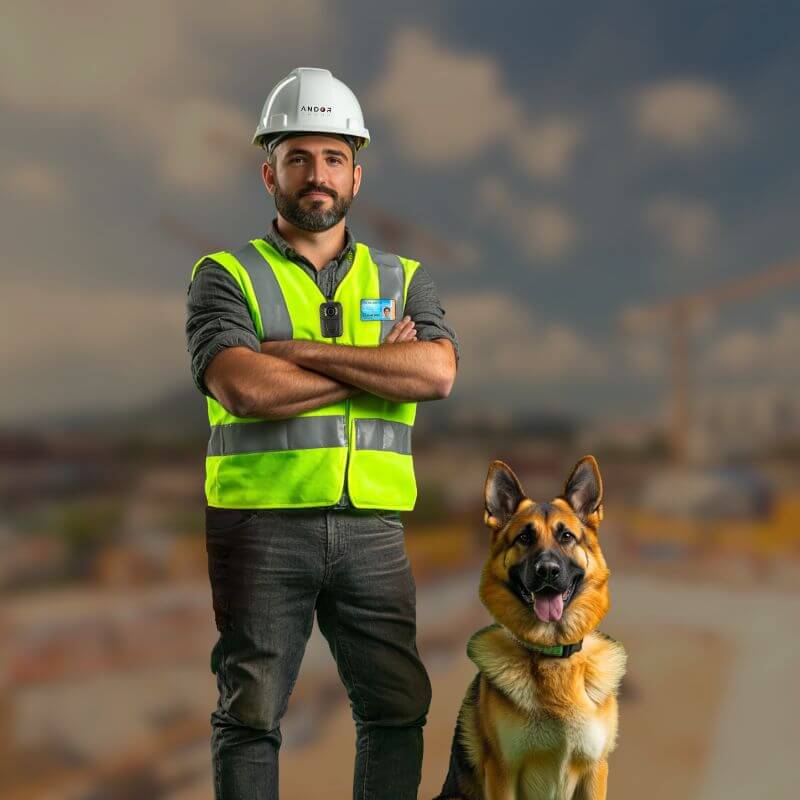
A dog handler covers ground that a person alone cannot. On a large, dark, partially built site with multiple ways in, a trained dog detects presence by scent and sound well beyond the range of sight, and does it while moving. For sites where intruders are getting in and conventional cover keeps missing them, that is usually the capability that was missing.
Andor Group provides security dog handler teams across the south of England and nationwide. Every handler is NASDU trained, through the National Association of Security Dog Users, and holds a valid SIA licence. Handler and dog work as a licensed, certified team rather than as a guard who happens to have a dog.
What a dog handler team adds
Detection across ground, not just sightlines
The practical advantage is search capability. A handler and dog can clear a large site, a part-built structure or a compound far faster than officers on foot, and will find someone concealed in a location a camera does not cover and a patrol would walk past.
Deterrence that is immediately understood
The presence of a dog team changes behaviour on arrival. For sites experiencing repeated intrusion, groups gathering, or trespass that has not responded to patrols and cameras, it is the most effective visible deterrent available.
Confidence to patrol properly
There are sites and hours where a lone officer should not be searching an unlit structure. A handler team can cover ground that would otherwise be left until daylight, which is often exactly where the problem is.
Support during higher-risk periods
Dog teams are frequently used for defined periods rather than permanently: during a shutdown, after a series of incidents, while a perimeter is being repaired, or over a weekend when a site is holding unusual value.
Where a dog team is the right answer
A dog team suits large or complex sites with multiple access points, sites with repeated intrusion that has not responded to other measures, sites with extensive unlit or part-built areas, and situations where searching needs to be quick and thorough.
It is not the default answer. A site with a sound perimeter and moderate risk is usually better served by a static officer or mobile patrols, and a site with good sightlines and power may be covered by monitored CCTV. A dog team is a specific capability for a specific problem, and we will say when the problem does not call for it.
Training, licensing and welfare
Handlers are NASDU trained and SIA licensed. Teams are certified together: the handler’s competence and the dog’s are assessed as a working pair, which is the basis on which they are deployed, and certification is kept current rather than obtained once.
Animal welfare is part of the service specification, not an afterthought. Dogs need appropriate transport, rest, water and shelter, and shift lengths reflect that. Where a site has no suitable provision for a handler team, it needs to be specified alongside the cover, including welfare accommodation where required.
Accreditation and reporting
Andor Group holds ISO 9001, ISO 14001 and ISO 45001, certified for security guarding services, together with SafeContractor accreditation and SSIP approval under the Deem to Satisfy process, and is a Constructionline Gold member, having also completed Constructionline’s Social Value assessment. We work to BS 7499 for static site guarding and mobile patrol services, BS 10800 for the provision of security services, BS 7984 for keyholding and response services, and BS 7858 for security screening, with BPSS clearance where a contract requires it. Dog handler teams additionally work to BS 8517, the British Standard covering the use of security dogs. Employer’s liability, public liability and professional indemnity insurance are each held at £10 million. Certificate numbers, scopes and expiry dates for every accreditation are set out on our accreditations page, and copies are available on request. Patrol activity, searches and incidents are logged through HitDesk and available to you directly, with attendance verified at check points in the same way as our other patrol services.
How a deployment works
Site visit before the first shift
We walk the site with you before deploying: access and egress for the handler’s vehicle, ground conditions, hazards and exclusion zones, where the team will be based, and the areas that most need searching. A dog team deployed without that walk will spend its first nights learning the site instead of covering it.
Assignment instructions
These set out patrol and search routines, check points, what the handler does on a detection, who is called and in what order, and any areas the team must not enter. They are written for your site rather than adapted from a template.
Review
Dog teams are often deployed against a specific problem, so it is worth reviewing whether the problem has stopped. Where intrusion ceases and the perimeter has been made good, we will usually recommend stepping down to a static officer or patrols rather than continuing at the higher specification.
Common questions
Are your dog handlers licensed and trained?
Yes. Every handler holds a valid SIA licence and is NASDU trained. Handler and dog are certified as a working team, and we can provide licence and certification details before mobilisation.
What kind of work are the dogs trained for?
General purpose security work: detecting and indicating the presence of people, searching buildings, vehicles and open ground, and supporting the handler during patrols and incidents.
Is a dog team suitable for a site near housing?
Often yes, and it can be less disruptive than repeated alarm activations. It depends on the site and neighbours, and we will look at it with you rather than deploy a team where it will create a different problem.
Can we use a dog team for a short period?
Yes, and that is common. Teams are frequently deployed for a shutdown, a weekend, or a defined period after a series of incidents, rather than permanently.
What happens if the dog detects someone?
The handler controls the situation, challenges where it is safe to do so, and follows the escalation procedure agreed in the assignment instructions, including contacting police and the site’s out-of-hours contact. The dog is a detection and deterrence capability under handler control at all times.
What does the site need to provide?
Safe vehicle access, somewhere for the team to be based with shelter and water, and clear information on site hazards, exclusion zones and any areas the team should not enter. We will walk the site before the first shift.
Can a dog team work alongside our existing security?
Yes, and that is often the most cost-effective arrangement. A static officer holds the gate and the compound while a dog team covers the wider site during the highest-risk hours, so you are not paying for handler cover across the whole shift when the problem sits in part of it.
Discuss a dog handler deployment
If a site is being repeatedly targeted, or you have ground that cannot be searched quickly, tell us what has been tried already. See the full range of construction site security services, or get in touch on 020 4602 3974 or at sales@andorgroup.com.
What our security dog handler teams provide
Intruder detection. Trained dogs detect presence by scent and sound well beyond the range of sight, finding people concealed where a camera does not reach and a foot patrol would pass by.
Visible deterrence. A dog team changes behaviour on arrival, and is the most effective visible deterrent available for sites facing repeated trespass.
Search capability. Rapid, systematic searching of open ground, part-built structures, compounds and vehicles, covering far more ground per hour than officers on foot.
Site patrols. Regular patrols using the dog’s senses to cover large or unlit areas that a lone officer could not safely or effectively search.
Controlled incident response. Handlers manage detections under agreed escalation procedures, with the dog under handler control throughout.
Certified as a team. NASDU-trained handlers holding valid SIA licences, with handler and dog assessed and certified as a working pair.
Values we live by
Collaboration with our partners
We work closely with our partners, fostering strong relationships to deliver tailored and effective security solutions.
Passion for results
Our team is driven to achieve exceptional results, ensuring every project meets the highest standards of safety, efficiency, and success.
Constantly improving
We embrace innovation and feedback, continuously enhancing our services to stay ahead in the ever-evolving security industry.